A Brief History of Japanese Mahjong
Mahjong does not have as long a history as one might assume, but its history is undoubtedly complex and extensive, especially since the game spread independently across many regions of Asia and later to the rest of the world. Without delving into the origins of the game in China, let us move directly to Japan. More specifically, let us go back to the 1920s.
In 1929, the first organization dedicated to mahjong players in Japan was established. It was the Japan Mahjong Federation (日本麻雀連盟), and its first president was the renowned writer Kan Kikuchi. They played a variant known as Arushiiaru, or Classical Japanese Mahjong. The name Arushiiaru comes from the Chinese term for the number 22, as this was the minimum base point value a winning hand could have.
This variant differed significantly from modern Japanese mahjong. First, a winning hand did not require a yaku (in other words, it did not need any han; hands worth 0 han were valid). A standard hand structure of four melds and one pair was sufficient (the exception being chiitoitsu, which was worth 0 han and 100 fu). Yaku did exist, but the list was much shorter than in modern mahjong, and their han values also differed. Dora did not exist, although there was already a dead wall. Riichi was not recognized, or at least not in the way it is today—a player could declare riichi only on the very first turn of the hand, similar to what is now known as double riichi. Furiten also existed, but it could be bypassed if the player explicitly declared it, allowing them to win by ron. A game consisted of four wind rounds with four hands each, running from East 1 through North 4.
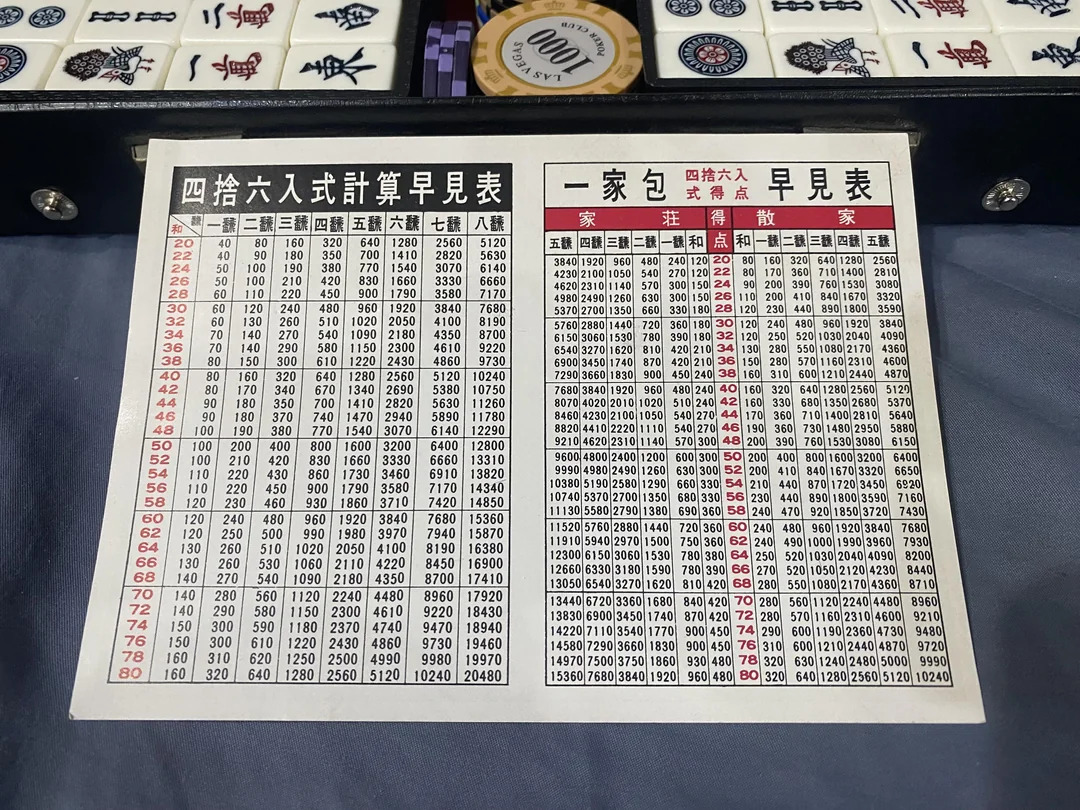
Arushiiaru scoring table.
Speaking of points, this is what the scoring table in Arushiiaru looked like. Originally, the final score depended solely on fu, which—as you can see—were not rounded up to the nearest ten, resulting in a much larger scoring table than the one used today. Han played only a secondary role: they were awarded exclusively for yaku and then converted into fu (typically, each han doubled the fu value). Based on whether the hand was won by tsumo or ron, whether the winner was the dealer (oya) or a non-dealer (ko), and the hand’s fu and han values, players would look up a base value in the table. This base value was then multiplied by the appropriate coefficients (which varied depending on who won and how the hand was won), and the result was rounded to the nearest ten to determine the final point value of the winning hand.
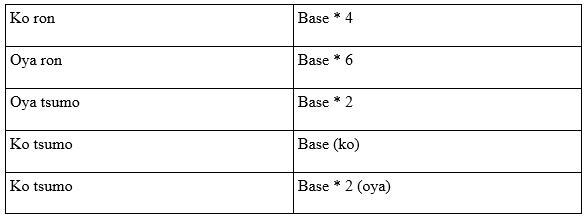
Table for counting points from the base
Overall, the flow of points was much lower than in modern mahjong, with point sticks carrying only one-tenth of their present-day value. Each player began the game with 2,000 points, and the highest possible payout was mangan.
Let us now say a few words about mangan. In a very loose translation, the word mangan means “a fortune,” though in practice it referred to the scoring limit, the highest possible payout. In English, mangan is sometimes translated simply as “Limit.” At the time, a mangan was worth 2,000 points for a non-dealer (ko) and 3,000 points for the dealer (oya).
A mangan could be achieved by accumulating multiple yaku, in which case it was called kazumangan (数満貫), or kazoemangan (数え満貫). However, if a single exceptionally difficult or rare yaku was sufficient to reach mangan on its own, it was known as yakumangan (役満貫). This is the origin of the modern term yakuman—a mangan attained through a single yaku. Consequently, in its original sense, a yakumangan and an ordinary mangan were worth exactly the same number of points.
The variant described above was the most widespread during that period. However, as is often the case with social games, each table ultimately played by its own house rules. Over time, the practice known as tochū riichi (途中リーチ)—declaring riichi at any point during the hand rather than only on the opening turn—began to gain popularity. The Japan Mahjong Federation, however, did not recognize tochū riichi as a legitimate rule.
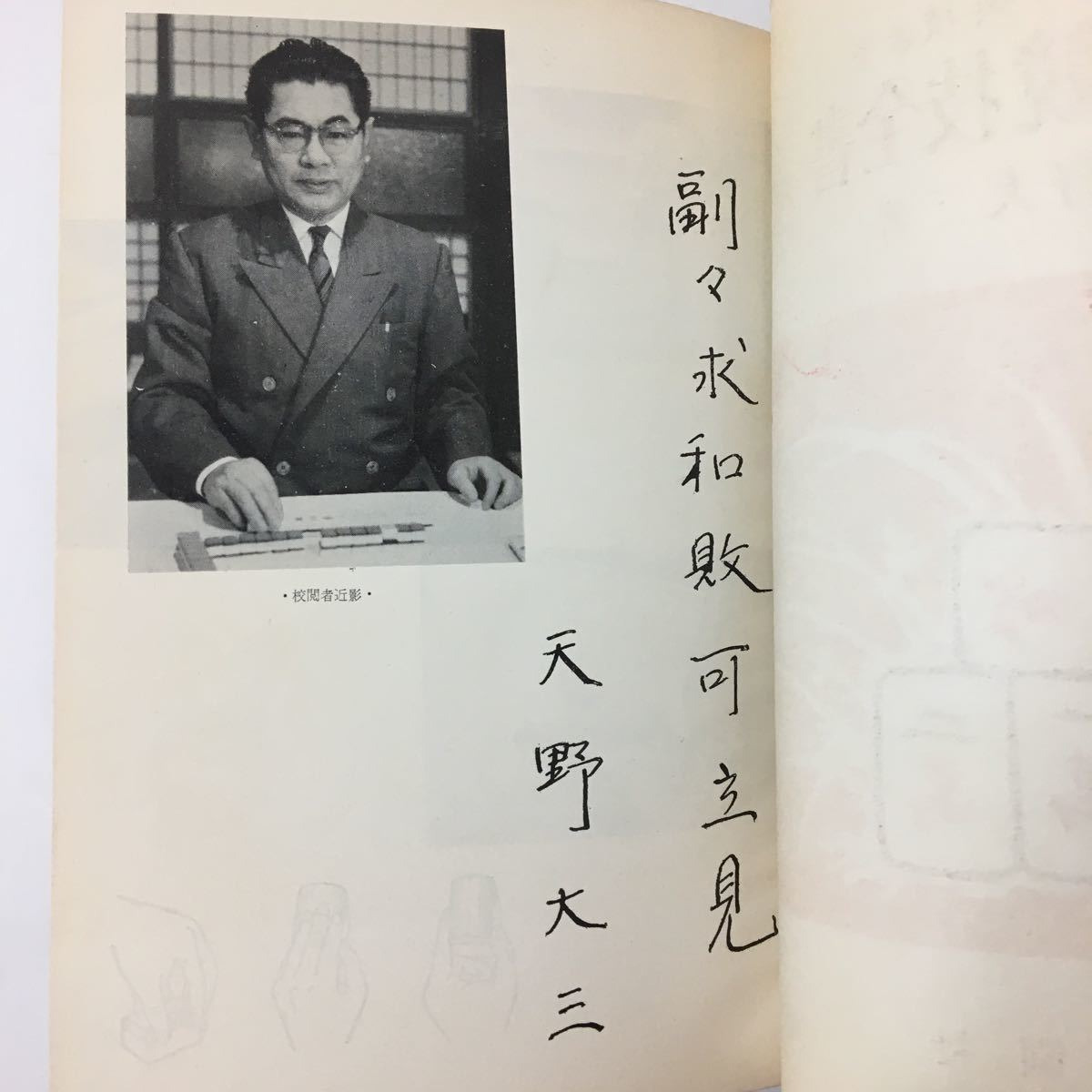
Amano Daizou
One of the federation’s members, Amano Daizou (天野大三), decided to create his own set of mahjong rules, which did not entirely agree with those promoted by his organization. Between november 11 and december 5, 1952, he published in the newspaper Houchi Shinbun (報知新聞) the rules for a game heavily based on tochuu riichi — a system he simply called riichi.
The game was played in the form of tontonsen (東々戦), meaning two East wind rounds, from East 1 to East 8. It was still possible to win without a yaku, but for the first time optional rules for honba and dora were introduced. Furiten applied only to genbutsu; a player could still win on other waits.
A new high-value hand was also introduced: daimangan / “large mangan” (大満貫), worth 1.5 times a mangan. To distinguish it from this, other high-value but less rare hands were called shoumangan / “small mangan” (小満貫). The only hand to receive special treatment was chuuren poutou, which was classified as a baimangan (倍満貫), worth twice the value of a mangan.
The rules above were the first codified version of riichi mahjong in history. They were known — after the name of the newspaper — as the “Houchi rules” (報知ルール).
At the time, certain yaku names sounded somewhat different from those used today. Names imitating the Chinese pronunciation were more common than the Japanized ones. For example, taa-san-yuan instead of daisangen, ii-chii-ton-kan instead of ikkitsuukan, san-sou-tou-shun instead of sanshokudoujun, or pin-hou instead of pinfu. Kokushimusou had a completely different name altogether: shii-san-yao-chuu (literally “thirteen terminal and honor tiles”).
Interestingly, popular rules from the 1940s stated that the dora was not revealed at the beginning of the game, but only after a win. The first tile from the edge of the dead wall was flipped over, and if a player had a tile identical to it in their hand, they received a predetermined number of points. It was only the Houchi rules that established the dora as the third tile from the edge of the dead wall, and that the tile following the revealed one was the actual dora indicator. Additionally, a new dora indicator was revealed whenever all currently active dora had been discarded by the players (or when someone made a kan using them). It was only many years later that this rule was changed to revealing a new dora after a kan was performed.
What happened next? The Federation was not particularly pleased with Amano’s act of independence, and one of its members secretly reported him to the police. He was released only after extensive explanations that his version of mahjong was intended to raise the level of competition. He regained his freedom, but the Federation retaliated for his “betrayal” by stripping him of his rank and his position on the board. They even told him: “If we ever accept riichi rules, we will come to you.”
Amano then left the Federation and founded his own competing organization, called the Japanese Mahjong Association (Nihon Haikii-in, 日本牌棋院). There, he intended to focus on riichi.
Amano’s pioneering contributions to modern mahjong did not end there. In 1957, he published another ruleset called “All 1-Han Shibari” (オール一飜縛り規程), also known as the “Tokyo rules” (東京ルール).
In this variant, the requirement of a minimum of 1 han appeared for the first time — in other words, a player had to have a yaku in order to declare a win. Furiten was extended to cover both waits of a ryanmen wait, even if only one of the tiles had been discarded. The zoroba (ゾロ場) rule was also introduced, under which the dice roll determined additional han that were added to a winning hand. This was intended to increase the value of wins.
Large and small mangans still existed, and chuuren poutou once again received its own special category — choumangan / “super mangan” (数満貫), worth four times the value of a mangan. It seems that for many decades already, chuuren poutou had been considered an exceptional hand even among the highest-valued hands.
In 1967, Amano published the so-called “modern rules” (gendai ruuru, 現代ルール). These introduced, for the first time, rounding fu up to the nearest ten, as well as bazoro (場ゾロ), oka, and ura-dora — all of which are still used today. Later, he published other variants, including proposals advocating the removal of the dead wall, but they did not achieve any significant popularity.
Let us take a moment to discuss bazoro, because although it remains an active part of mahjong scoring, surprisingly few people are aware of its existence. Both the name zoroba and bazoro come from the word zorome (ゾロ目), meaning identical numbers rolled with multiple dice.
Consider common gambling games based on dice rolls. If a dealer rolls the same number on two dice, the payout is doubled, because in gambling there is a natural desire to achieve the largest possible winnings. The idea here was similar. Under the zoroba rule, the dice roll determined how many han were added to the winner’s hand. If the two dice showed the same number from 2 to 5, 1 han was added; if they both showed 1 or both showed 6, 2 han were added. Over time, however, this rule was changed.
Bazoro (also known as ban-ban, den-den, ryanzoro, or zoro-zoro) was a new rule according to which every winner received an additional two han added to the value of their hand. The dice roll or any other circumstances no longer mattered — two han were simply added every time.
For example, if a player won with a hand worth 1 han 30 fu, the actual value of the hand was considered to be 3 han 30 fu. Because of this, some scoring tables did not begin at 1 han, but at 3 han.
So how did this survive into the modern game? The answer is that bazoro is effectively already built into modern scoring tables. Let us take a 1 han 30 fu hand as an example. The han doubles the fu value once, giving us 60 fu. If we win by tsumo as a non-dealer (ko), the other players pay: 60 (ko) + 60 (ko) + 120 (dealer pays double) = 240 points.
However, if we add the 2 han from bazoro (doubling the fu value two more times), the result suddenly becomes: 240 (ko) + 240 (ko) + 480 (dealer) = 960 points.
After rounding to hundreds, this becomes 1000 — exactly the value of a 1 han 30 fu hand in modern scoring tables! This is why, despite bazoro technically still existing, it does not need to be calculated separately, because it is already incorporated into the result. If, however, we calculated scores in the old-fashioned way based on fu, applying bazoro would give us the correct result.
It is all terribly complicated… No wonder that other mahjong variants outside Japan completely abandoned the division between fu and han and standardized their scoring systems. However, calculating scores through base points has a certain undeniable charm — a subtle logic behind it that is difficult to dismiss.
Over time, mahjong scores continued to grow through the addition of various rules, such as kandora, akadora, and others. This was called mahjong inflation, or infure (インフレ). The values of scoring sticks were increased tenfold, mangan was no longer the only major winning hand, and haneman, baiman, and sanbaiman appeared. At one point, sanbaiman, yonbaiman, and gobaiban were also called yakuman, but this was later standardized. Eventually, yakuman was assigned a value equal to four times mangan.
To simplify calculations, fu began to be rounded to the nearest ten, while the final score was rounded to the nearest hundred, and… this is how we arrived at the modern game, where riichi mahjong has largely overshadowed Arushiiaru, and has even become popular in countries that have their own mahjong variants, such as China, Singapore, and Taiwan.
A humorous irony remains: although the Japanese Mahjong Federation still recognizes Arushiiaru as its primary variant, it officially accepted riichi mahjong rules as a second approved variant in 2016 — 34 years after Amano’s death.
Author: Yuria
Warmian-Masurian Mahjong Club „Hassouhatsu”